


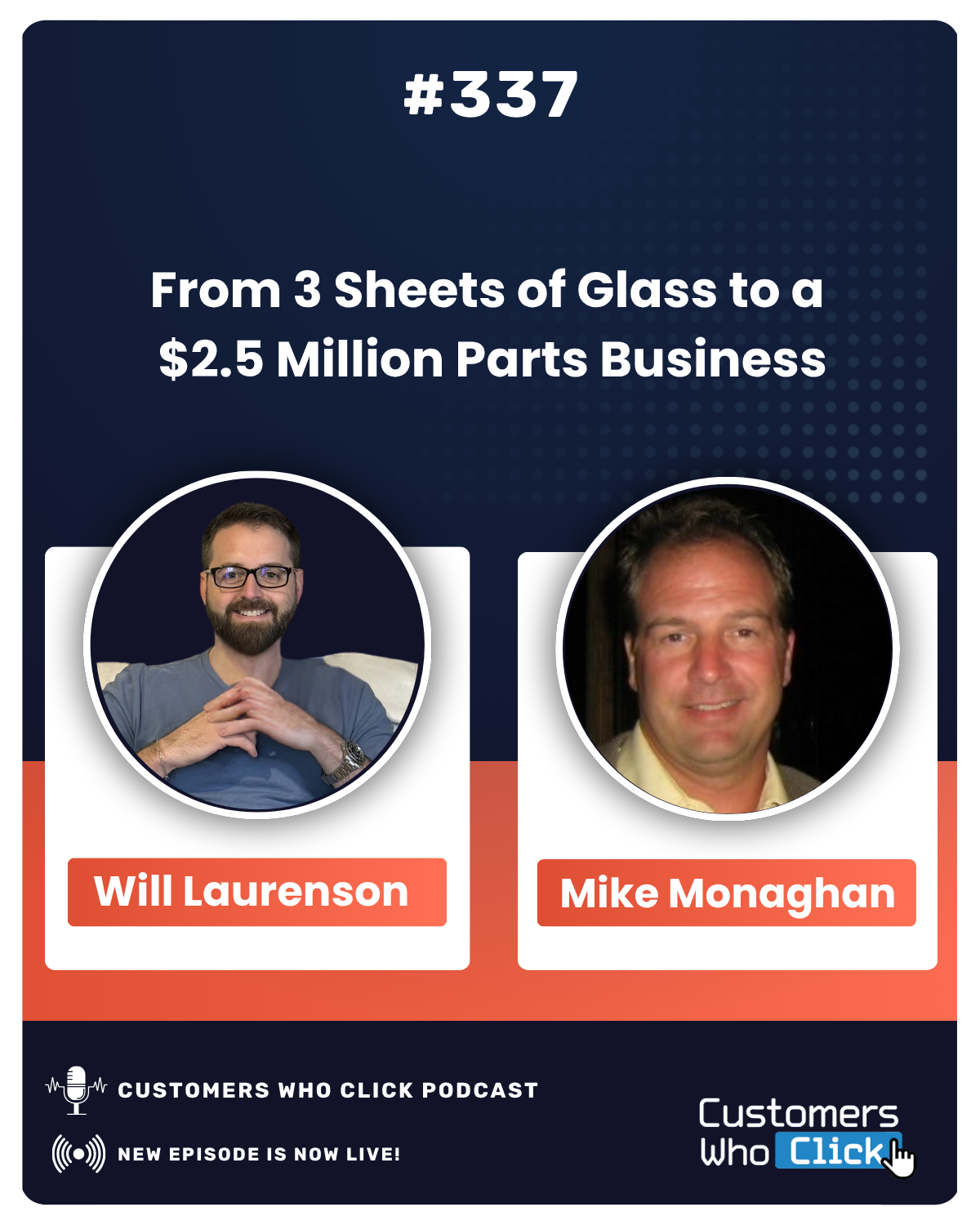
337. The Parts Brand That Wants You to Call Before You Order (and the Seasonal Swing From $400,000 to $100,000) - Mike Monaghan, Total Hearth
Mike Monaghan's customers are often stuck in the middle of winter with a broken wood stove and nothing else to heat the house. That is why Total Hearth puts its phone number front and centre and asks customers to call before they order, rather than hoping they pick the right part.
Mike is owner of Total Hearth, an e-commerce brand selling replacement parts for wood stoves, fireplaces and pellet stoves. He started in sales at a wood stove company, then bought a commercial glass business and ran it for more than 20 years. When he spotted a shortage of ceramic glass, the high temperature glass used in wood stoves, he built a website to sell it. Sales have roughly tripled in the 5 years since it became his full time focus, and the parts business is up 15% this year, on track for $2.5 million.
Start with 3 sheets of glass
Mike built the first version of the site himself, using a platform called Site Build It that explained why he was doing each step, not just what to do. A supplier sold him 3 sheets of ceramic glass at around $1,000 a sheet. He listed the products he knew would get interest, they sold quickly, and he bought 5 sheets, then 7, then 10. Within a couple of years the site had outgrown the glass business he was running.
Make it easy to call, text or chat
"We put our phone number real prominent on our site just for that reason, because a lot of sites don't. And to me, I'd rather have a customer call me and say, I'm not sure if this is the right thing for me or not, than me sending the wrong thing and it's back and forth," Mike said. Texts and chats pop up on his screen, and he answers them himself.
The phone number also works as proof the business is real. Mike has seen lookalike sites a spelling off Total Hearth's address selling parts at a third of the price, and he knows they are only after card details.
Ask for the brand and model, not what it looks like
One part can fit 35 different brands, so Mike asks customers for the brand and model, or a photo of the plate on the back of the stove. Describing a part by how it looks does not work. "That's like saying I got a Ford truck and it looks like a Chevy truck. I don't know which bumper I need," he said.
Will Laurenson pointed out that a photo also avoids typing errors, and lets a business spot related parts the customer is likely to need as well.
Use AI as a watchdog, not a driver
Mike's customers skew older, and he said many dislike anything that feels like a robot. So Total Hearth uses chat that lands with his team and a few automated answers, such as shipping cut-offs, rather than AI phone calls.
He does use AI every day as a check on the numbers. He knows shipping should come in at 10% or under of sales volume, so AI now flags when it drifts. He also knows another business that handed much of its back end to AI while its sales kept falling. "I still gotta keep my hand on that steering wheel," he said.
The seasonal roller coaster
Sales peak from October to February, while overheads run all year. Cash can fall from around $400,000 to $100,000 before Mike restocks for the next season. As the business grows, those swings get more extreme, even though every year is better than the last.
His answer is to add lines that sell when wood stoves do not. He is looking at RV parts, pool parts and HVAC motors, categories where he already knows how things work, and building them slowly rather than putting $500,000 of motors on the shelf at once. The site is shifting from Total Hearth to Total Hearth and Home, with separate niche sister sites planned as each line builds.
Key takeaways
- Put contact details front and centre on a parts site, because a call before ordering costs less than a wrong part
- Ask for brand, model or a photo of the plate rather than a description of what the part looks like
- Test demand with a small first order, then reorder as it sells through
- Use AI to double-check numbers like shipping cost as a share of sales, not to run the business unattended
- Plan for the off season before growth makes seasonal cash swings bigger
- Add counter-seasonal lines in categories you already understand, and build them slowly
Monaghan describes the expansion as a slow burn, because every new line has to earn customer trust. Listen to the full episode to hear how he is planning for the quiet months.