


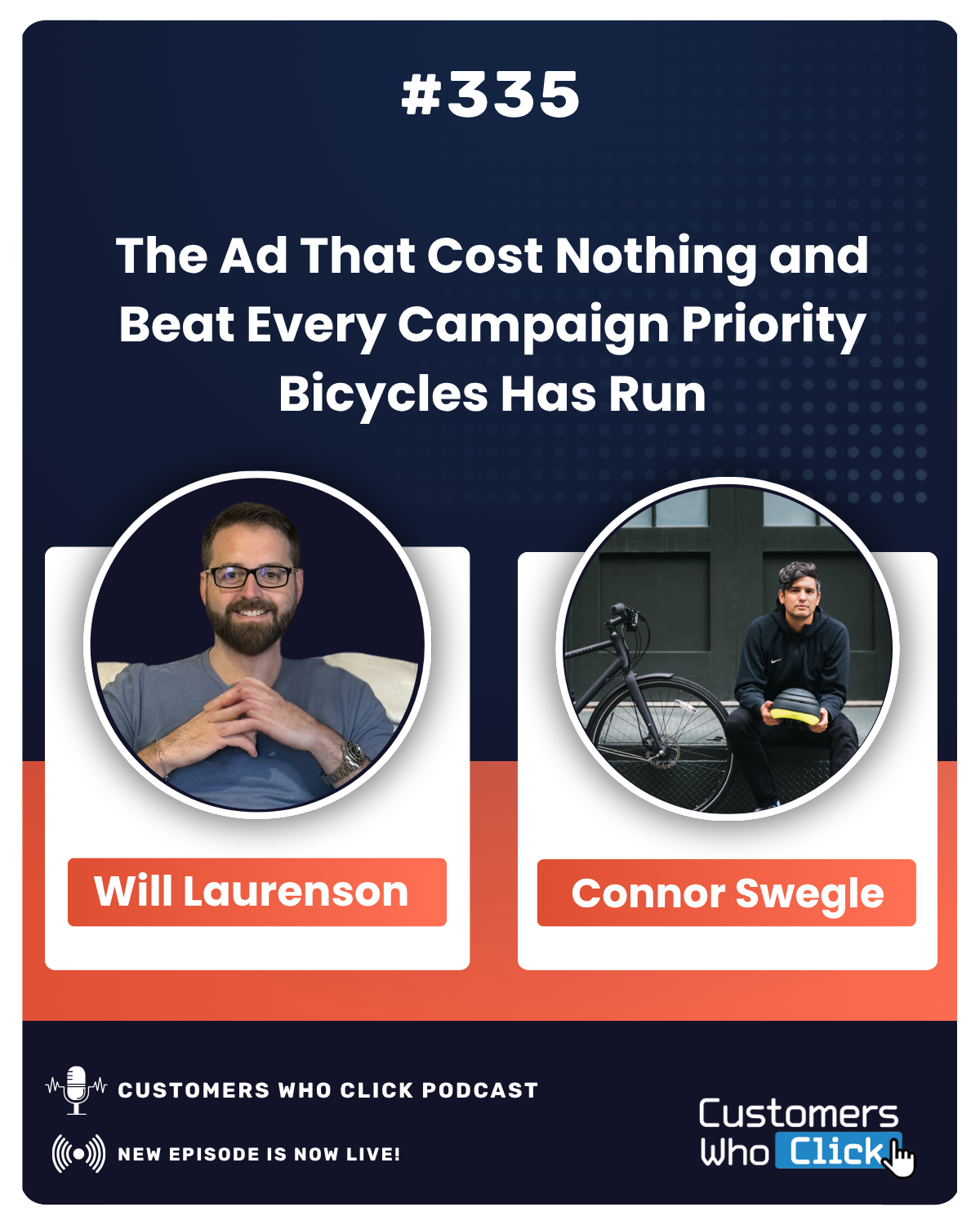
335. The Ad That Cost Nothing and Beat Every Campaign They've Run (and the Free Lock They Stopped Giving Away) - Connor Swegle, Priority Bicycles
Priority Bicycles has spent 12 years selling bikes online in a category most people assume is settled: bike shops, big box stores, done. Connor Swegle, the brand's CMO, thinks the reason it worked is simple. They didn't try to convince everyone a bike was a good idea. They found the specific reasons people weren't buying, and built the whole funnel around removing them.
Swegle is CMO of Priority Bicycles, a direct-to-consumer brand that launched with a single bike on Kickstarter during what he calls the post-Warby Parker era of D2C. Twelve years on, Priority sells more than 33 models across three brands, all built around a belt drive instead of a traditional chain, and ships bikes "95% assembled" in a box with the tools included, so a new rider can be on the road inside half an hour.
Define the top of funnel by who wouldn't buy
Most brands size their top of funnel by addressable market. Swegle does the opposite. He starts with the objections. "These are where do they live, what type of riding are they doing, why wouldn't they buy," he said, describing how Priority defines a cold customer before it spends a pound on media. Chasing raw market size, he said, is "a terrible place to start because you will bleed out your advertising money very quickly."
That filter also shapes what the brand says once it has someone's attention. Swegle's rule of thumb is to think about the one fact that would make a stranger say "tell me more." For Priority, that fact isn't the belt drive itself, a term most people don't recognise. It's what the belt drive means: a bike you will never have to tune up.
A rainy day, 20 minutes, and the best ad the brand has ever run
Priority's highest performing ad wasn't a big production. On a rainy day, the team stepped outside their Manhattan office and spent 20 minutes splashing through puddles on camera. The resulting ad, built around the line "commuter bikes built for all conditions, just like you," delivered the highest click traffic and return on ad spend Priority has recorded. Swegle said it worked because it stated one true, specific fact that the audience already cared about, rather than trying to sell an ideal.
The "explain it to your partner" test
For a purchase above impulse pricing, Swegle asks a single question before writing site copy: would the customer have to justify this to a partner or a friend? If the answer is yes, vague brand appeal isn't enough. The site has to hand the customer specific, sharable reasons, delivered in the right order as they scroll, because "you have to be very clear... we nurture through scroll on our site."
Stop bundling freebies that don't solve anything
Priority used to offer a free lock with bike orders. It stopped, because a free lock doesn't answer any real objection to buying a bike. "If I tell you that I'm throwing in a free lock, that's not a problem that you have. That's not keeping you from buying," Swegle said. Instead, the team builds accessory bundles tied to an actual next purchase, like a rear rack and pannier bag for a commuter buyer, which has lifted average order value by around 15%.
Repeat purchase rate: higher than expected
Priority isn't built around lifetime value the way a skincare or apparel brand might be. Even so, Swegle said 65 to 66% of Priority's customers buy more than once, a number he admitted surprised him given how much work goes into convincing someone to buy a bike online in the first place.
Why Swegle ignores platform ROAS
Connor's clearest position in the conversation was on ad platform metrics. He estimates that ad platform click numbers are inflated by at least double, and said he disregards ROAS as a decision-making metric entirely. Instead, his team watches what happens after the click: traffic to the product page, scroll depth, cart adds, and abandonment.
His diagnostic for a stalled campaign is simple. Install a free heatmap tool through Shopify's app store, point it at a top performing page, and run it for one to two weeks. If the traffic doesn't scroll or click anything, the ads are the problem. If it does, the site is.
Key takeaways
- Define your top of funnel by the specific reasons people wouldn't buy, not by total addressable market size
- A simple, true, low-cost ad can outperform a polished paid campaign if it states a fact your audience already feels
- For considered purchases, ask whether a customer would need to justify the buy to someone else, then put that justification on the page
- Cut freebies that don't answer a real objection, and replace them with accessory bundles tied to an actual next purchase
- Treat platform ROAS as directionally unreliable, and weigh on-site behaviour like scroll, cart adds, and abandonment instead
- Run a two week heatmap test on your top page before assuming a stalled campaign is an ads problem
Priority's next challenge, Connor said, is reaching people who don't yet know low maintenance, belt drive bikes exist at all. Listen to the full episode to hear how he's thinking about scaling that awareness without simply spending more.